
USTBC President Comments on U.S.-Taiwan Security Cooperation
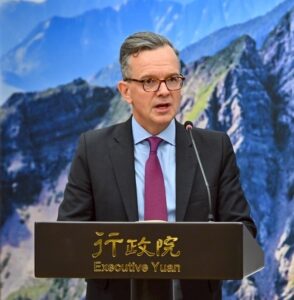
On April 15, 2026, in an article called The New Context of U.S.-Taiwan Security Cooperation published by AmCham Taiwan‘s Taiwan Business TOPICS magazine, Council President Rupert Hammond-Chambers commented on the U.S.-Taiwan defense partnership.
Rupert Hammond-Chambers, president of the U.S.-Taiwan Business Council, says the shift toward asymmetric capabilities makes sense — within limits. “Since 2020, Taiwan’s procurement has been heavily focused on asymmetric systems — drones, counter-drones, command-and-control, and what’s often described as a ‘Taiwan dome,’” he says. “The risk is that this narrows the focus too much.”
Blockades, quarantines, and other gray-zone activity may present more immediate challenges than a full-scale invasion, he notes.
“Quantity has its own quality,” Hammond-Chambers says. “If you’re pursuing an asymmetric strategy, you need the capacity to produce and replace systems at speed.” Taiwan’s manufacturing base is well-suited to that task, particularly in sectors aligned with its existing strengths in electronics and advanced production.
In the same issue of Taiwan Business TOPICS, President Hammond-Chambers was also quoted in an article called “Moving the Finish Line: Taiwan’s $40 Billion Defense Test.”
Rupert Hammond-Chambers, president of the Washington area-based U.S. Taiwan Business Council, argues that Taiwan’s recent procurement decisions have been shaped by a relatively narrow interpretation of asymmetric defense. “The focus has largely been on building out capabilities within a relatively constrained framework,” he says.
He points to a pattern of reinforcing systems Taiwan already operates, with relatively little diversification into areas such as blockade response, quarantine scenarios, or gray-zone operations. The concern, he says, is not with the concept of asymmetry itself, but with its application — and the capability gaps that may emerge across a broader range of contingencies.
Hammond-Chambers stresses the importance of industrial capacity, noting that “quantity has its own quality” in a situation shaped by attrition. In this context, the ability to produce and replenish systems at scale becomes a core component of deterrence rather than a secondary consideration.
Taiwan’s manufacturing base provides a strong foundation, but translating that capacity into sustained defense output presents a challenge.
The issue is not only what Taiwan buys, but how its capabilities are integrated. Hammond-Chambers refers to command-and-control as a central issue, as Taiwan’s force structure is a collection of systems not yet fully integrated into a cohesive operational framework.
Hammond-Chambers sees growing opportunities for Taiwan to participate more directly in defense supply chains, including through joint production and technology transfer. Realizing that potential, however, will require closer alignment between procurement decisions and industrial strategy.
Without that alignment, expanded procurement risks building inventory without building endurance — a gap that initially may not be perceptible but later impacts the ability to sustain operations over time.